Tuesday, February 28, 2012

Rye Waffles with Clementine Syrup


Waking up last Saturday to an unexpected dusting of snow on top of the tulips called for a cozy waffle breakfast. And with plenty of rye flour from our Lonesome Whistle Farm CSA, I thought I would experiment with rye waffles, along with the trick of using corn starch in the batter for an extra crispy outside.


We often turn to our freezer chest of summer berries and peaches for waffle topping, but on this wintery morning, I thought I would use some seasonal clementines quickly warmed in maple syrup.


The rye flour gave the waffles a pleasant tartness, whipped egg whites kept them etherial, and the corn starch trick worked for crispiness. The clementine syrup, drizzled over a dollop of yogurt and a sprinkle of toasted almonds, had the taste of sunshine. And the smell of waffles lingered in the kitchen all morning, outlasting the snow.


Rye Waffles with Clementine Syrup
(makes about 6 waffles)
waffle batter 
3/4 cup soft white winter wheat flour
3/4 cup rye flour
1/2 cup corn starch
1 tsp baking powder
1/2 tsp baking soda
pinch of salt
2 cups buttermilk
2 eggs, separated
1/4 cup vegetable oil
2 Tbsp brown sugar
1 tsp vanilla extract


for topping
plain yogurt
slivered almonds, toasted
clementines (about 1 per person)
maple syrup (about 2 Tbsp per person)


1. Combine the dry ingredients (flours, cornstarch, leaveners, and salt). Whisk together the buttermilk, egg yokes, vegetable oil, brown sugar, and vanilla extract. Combine the dry ingredients into the wet ingredients, but do not over mix. At this point you should let the batter sit for at least 30 minutes to allow the cornstarch to cross link gluten in the flour, which will give the crispiness to the waffles.


2. Prepare the clementine syrup. Peal the clementines, slice them to bifurcate the sections, and separate them. In a small saucepan, combine the clementine pieces and the maple syrup and heat just until small bubbles start to form on the edge of the pan. Turn off and reserve for serving. Toast the almond slivers and reserve.


3. To finish the waffle batter, beat the egg whites until stiff. Fold these into the batter. 


4. Heat a waffle iron and cook the waffles. Store them in a 200 degree oven or eat them immediately as the come off the waffle iron, topped with a dollop of yogurt, a sprinkle of toasted almond slivers, and the clementine syrup.


Other recipes for locally grown grains

Thursday, February 23, 2012

Barely Any Work Barley Lunches


What I'm learning about cooking with whole grains, like this lovely purple hulled barley from our Lonesome Whistle Farm CSA, is that you should cook up a pot before you have a plan for them. Set them simmering over dinner, or cook them in a slow cooker while you run errands on the weekend. Then, because you have some ready cooked grains in the refrigerator, inspiration will strike. 


The same principle applies to winter vegetables, of which we have plenty from our Open Oak Farm CSA: roast them, braise them, saute them, and they are sure to come in handy. It's a way of turning slow cooking into easy, fast food. 


With these ingredients on hand, you can whip together a satisfying lunch at the office of a barley and root vegetable salad topped with cubed cheddar cheese,


or a scrumptious quick weekend lunch of purple barley and leftover braised red cabbage, topped with a fried egg and a dollop of harissa.  The possibilities are infinite, and all infinitely better than most quick meals you would purchase on the go.


Hulled Barley
1 cup hulled barley, picked over
2 1/2 cups water
generous pinch of salt

In a dry skillet, toast the barley until fragrant. Then combine with the water and salt and simmer on low, covered, for about 1.5 hours until tender.


Barley and Root Vegetable Salad
pack
One container with a couple handfuls of greens
One container with about 1/2 cup cooked barley and 1/2 cup roasted root vegetables
a chunk of cheddar cheese
a small container of olive oil and vinegar


assemble
Pour the olive oil and vinegar over the greens, reseal the container and shake to dress. Top with the barley and root vegetables and crumble on the cheddar cheese. Enjoy.


Barley and Braised Cabbage with a Fried Egg

Microwave about 1/2 cup cooked barley topped with about 1/2 cup braised cabbage. 
Fry an egg and place on top of the warm cabbage and barley. 
Top with a dollop of harissa. Enjoy.


Other recipes for locally grown grains

Friday, February 17, 2012

Arikara Almond Bean Spread


This humble bean spread sustained me for a full week of lunches. It was an experiment, and a successful one. I wanted to make something like humus with the last of my stash of Arikara heirloom beans from Lonesome Whistle Farm, but I wanted to explore different culinary terrain.


So instead of sesame seeds, I substitute toasted almonds.


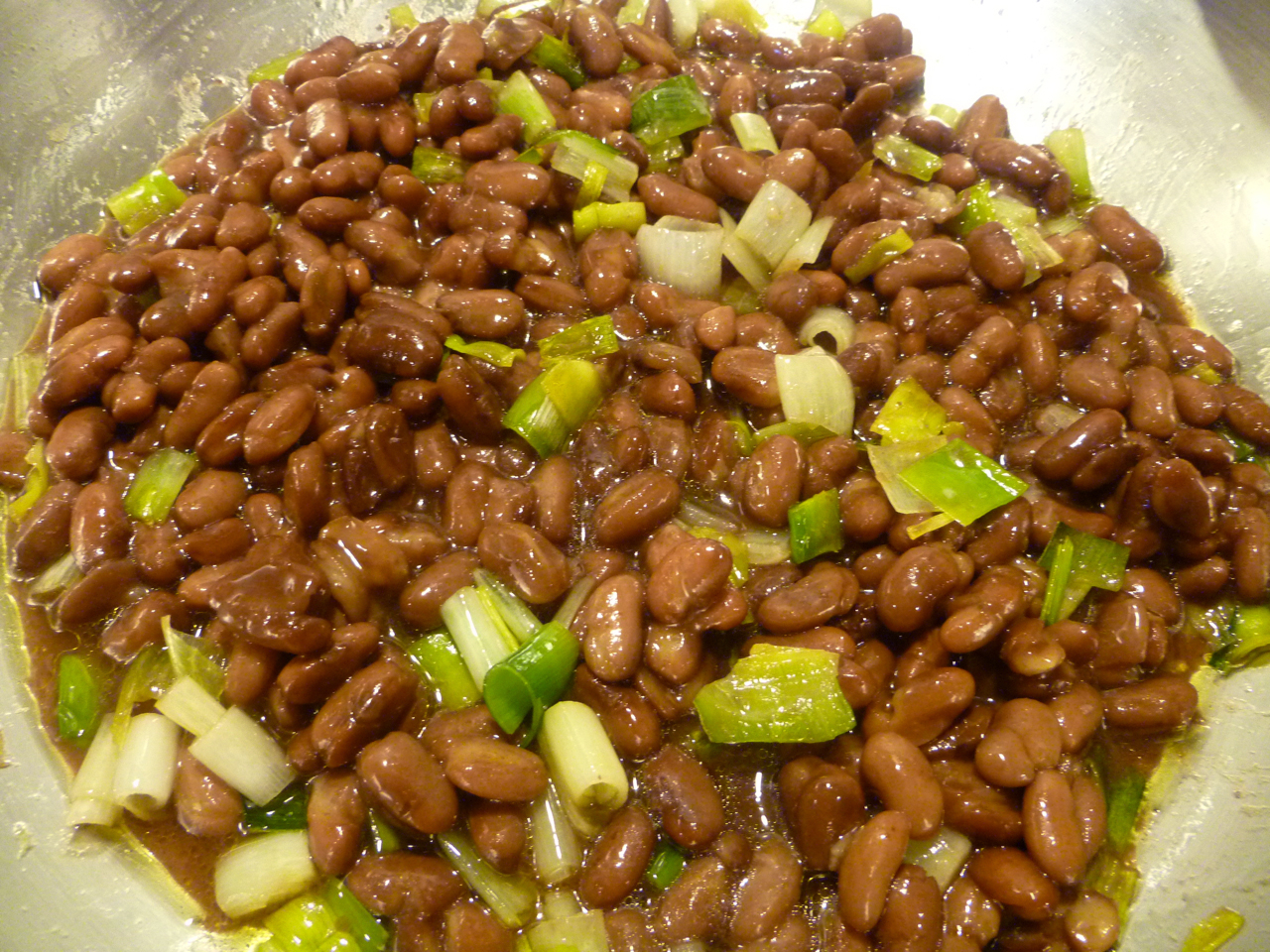
Rather than garlic, I used leeks slowly sauteed in olive oil, into which I stirred my soft cooked beans. Then, because this dish seemed to be journeying from the eastern Mediterranean toward the Iberian Peninsula, I finish off the pureed paste with a splash of sherry vinegar and a dusting of smoked paprika. The final dish tasted almost like pâté, rich and flavorful, with a hint of sherry. It made a nice dip for raw vegetables and a great lunch spread on fresh bread accompanied by fruity salads. 


Arikara Almond Bean Spread


1 cup Arikara beans (or substitute white kidney beans)
several sprigs of thyme
3 1/2 cups water
1 large or 2 medium leeks
4 Tbsp olive oil
1/2 cup whole almonds
2 tsp sherry vinegar
salt
smoked paprika for garnish


1. Rinse the Arikara beans and cook them on very low heat with about 3 1/2 cups of water, the thyme sprigs and a pinch of water until very soft, about four hours. Add more water during the cooking process if necessary and when the beans are done, add more salt to taste. 


2. Remove the root and green stem from the leek, slice lengthwise, and wash thoroughly. Cut into 1/2 inch slices. Heat a large skillet over medium low heat, add the olive oil, and saute the leeks for about 10 minutes, until they are very soft, but avoid browning them. Add the cooked beans and their cooking liquid and simmer with the leeks to meld the flavors and reduce the broth. The final mixture should have about about a half cup of syrupy liquid remaining. 


3. Meanwhile, toast the almonds in a dry skillet until fragrant. Transfer them to a food processor and pulverize into a fine meal. Add the leeks and beans and process for several minutes until smooth. Add the sherry vinegar and pulse. Taste and add more salt if necessary. 


4. Transfer to a bowl and dust with smoked paprika. Serve with fresh vegetables or crusty bread. 


Other recipes for locally grown beans
Barley and Cranberry Bean Soup with Kale
Bruna Bönor
Cranberry Beans and Collard Greens
Paprkia Chickpea, Delicata and Kale Salad
Pumpkin and Rio Zape Bean Soup
Vegetarian Bean Chili
Black Beans and Huevos Rancheros
Falafel and Grilled Zucchini
Lentil Caviar Salad with Poached Eggs
Coffee Braised Lamb Shanks and Arikara beans
Green Flageolet Bean and Tuna Salad
Creamy Green Flageolet Beans
Dutch Bullet Bean Soup with Indian spices
Arikara Beans with Tomatillo Pork
Ireland Creek Annie Baked Beans
Flageolet Bean Salad with Fennel, Orange, and Tapenade
Arikara Beans with Roasted Fennel and Peppers
Jacob's Cattle Bean and Ham Stew
Calypso Beans with Ginger and Black Mustard Seeds
Ireland Creek Annie bean bruschetta
Lemon and Herb Dutch Bullet Beans
Minty Green Flageolet Beans
Dutch Bullet Beans and Roasted Squash Soup
Rio Zape Beans with Toasted Chile Sauce
Arikara Bean Gratin
Calypso Bean and Leek Soup

Tuesday, February 14, 2012

Red Lentil Soup


I would have liked to have cooked up a fancy Valentine's Day meal, complete with this fabulous chocolate mousse, but busy travel itineraries, wintertime colds, and the demands of supervising the production of 99 cards, thwarted such plans. 


In the end, it seemed fitting to turn to a well-loved family standby. This is a fragrant red lentil soup from Melissa Clark, that is delicious in its original incarnation, but which I've tinkered with over the years, adding more spices along with the cumin, and some sun dried tomatoes to the broth, and blending it into an intoxicatingly velvety and exotic puree.


I'm a little surprised that this spicy soup is a favorite with my chile-averse children. I think my daughter likes its smooth, silky texture, and my son probably finds the flavors familiar because I ate this so often when he was in utero. They also both love being able to play with the accompanying lemon wedges to their hearts' content. And I love being able to serve a simple, heart-warming meal that elicits repeated requests for additional helpings. Really, what better Valentine's Day gift is there than having one's food, cooked with love, be greeted with heartfelt enthusiasm? 


Red Lentil Soup
Adapted from Melissa Clark
serves four


3 tablespoons olive oil
1 medium onion, peeled chopped
2 carrots or 1 carrot and 1 parsnip, peeled and diced
2 Tbsp tomato paste
2 tsp ground cumin 
1/2 tsp smoked paprika
1/4 tsp chipotle chilli powder 
1/4 tsp cayenne
salt to taste
1 quart chicken or vegetable broth plus two cups water (or use six cups water with 2 tsp Better than Boullion)
1/4 cup chopped sun dried tomatoes
1 1/4 cup red lentils
lemon wedges for garnish
chopped fresh cilantro for garnish

1. In a large pot, heat 3 tablespoons oil over medium high heat until hot and shimmering. Add onion and sauté until it starts to caramelize, then add the diced carrot (and parsnip if using) and sauté until soft, about 5 minutes.

2. Add spices and sauté until fragrant.  Then stir in the tomato paste, and sauté for 2 minutes longer.

3. Add lentils and coat in spice paste.  Then add broth and water and sun dried tomatoes. Bring to a simmer, then partially cover pot and turn heat to medium-low. Simmer until lentils are soft, about 30 minutes. Taste and add salt if necessary.

4. Using an immersion or regular blender or a food processor, purée the soup until smooth.

5. Reheat soup if necessary, then serve with lemon juice and cilantro. 

Friday, February 3, 2012

Rutabaga Dduk Bokki


It's a little difficult to love a rutabaga. Compared to a genial, mild mannered potato, a rutabaga can come across as sharp and bitter. I like to temper its impact by roasting it together with a variety of root vegetables; mixed in with mellow, earthy parsnips and sweet beets, it brings complexity and depth to the discussion. 


But maybe the rutabaga is just a bit misunderstood, and we should stop thinking of it as a bitter potato and embrace it as a big, lovable radish. In this way it can play a staring role in Asian dishes, standing in for sharp, crisp daikon. 


During my first pregnancy I had strong cravings for sweet and spicy Korean stir fries that more than once sent my husband to Cafe Seuol for late night take out orders. Recently I've been experimenting with making a Korean street food, dduk bokki, that features these fun rod-shaped rice cakes. I started with this recipe, but wanted to include more vegetables, and it turned out that rutabaga was the perfect fit, adding bulk and a sharpness that balanced the sweet carrots and leeks.


This dish worked well for dinner because the kids enjoyed it deconstructed, having developed a taste for teriyaki beef from Ume Grill, and the grown ups enjoy a flavorful and satisfying one pot meal. And I think the rutabaga enjoyed being appreciated for its unique and special qualities. 


Dduk Bokki


Note: this recipe includes teriyaki style beef, but for a vegetarian version, you could simply omit the beef or substitute in baked tofu.

Marinated beef
1/3 lb beef, such as tri tip
1 tsp sugar
2 Tbsp soy sauce
4 Tbsp rice wine
plenty of black pepper
2 Tbsp canola oil
1 tsp corn starch

Rice stick stir fry
1/2 lb rice cakes (available at Asian markets in the freezer section)
2 cloves garlic, peeled and minced
2 Tbsp sugar
2 Tbsp gochujang (Korean red pepper paste, in a box like this)
1  Tbsp soy sauce
2 Tbsp sesame oil
1 rutabaga
2 carrots
1 leek (or 1 bunch of green onions)
2 medium bok choy or 1/2 small cabbage
1 Tbsp canola oil
sesame seeds for garnish

1. Set a large pot of water to boil. Slice the beef into thin slices. Stir together the sugar, soy sauce, rice wine, and black pepper, and marinate the meat in this while you prep the vegetables and rice cakes.

2. When the water is boiling, add the frozen rice sticks and cook for about 5 minutes until they are cooked through (taste to make sure). Then drain them in a colander and drizzle over a little canola oil to prevent them from sticking.

3. Peel the rutabaga and carrots and cut them into small matchsticks. Trim the root and green ends from the leek, slice lengthwise, and wash thoroughly. Then cut into 1/2 inch slices widthwise. Chop the bok choy or cabbage into thin strips.

4. Mix together the minced garlic, sugar, gochujang, soy sauce, and sesame oil and set aside.

5. Heat a large skillet or wok over medium high heat. Add the oil and when it is hot, add the sliced meat. Cook for a couple of minutes and then flip with tongs to cook the second side. Mix the cornstarch into the marinade, and when the beef is cooked through pour over the corn starch mixture and cook for another minute, stirring. Remove the beef to a plate, scraping off as much of the sauce as possible.

6. Return the pan to the heat and add a little more oil. When it is hot, add the rutabaga and carrot matchsticks and cook for a couple of minutes. Once they start to soften slightly, add the leeks, cook for a minute, and then add the bok choy or cabbage. Keep cooking and stirring until the vegetables are cooked through but still slightly crispy. Add the rice cakes and toss with the vegetables. Then add back the cooked beef and stir in the gochujang sauce. If the sauce seems too thick, you can add a little water. Cook everything together until it is warmed through and then remove from the heat and serve garnished with sesame seeds.

Monday, January 30, 2012

Fresh Corn Tortillas


The best kind of present is one that arrives out of the blue, a package on your doorstep when you are least expecting it. A couple of weeks ago the mailman left me a tortilla press, a thoughtful early birthday gift from my sister-in-law. I'd never made fresh tortillas before, but now I had a mission. It turns out that corn flour and water are lots of fun to mix, squishing between your fingers, especially if you are four.


Although at first it seems like a crumbly mess, the mixture comes together into a smooth, soft dough. The tricky part is handling it after it has been flattened. You need to line the press with plastic wrap, and avoid pressing the dough too thin. Here again, being four comes in handy because your maximum strength produces a tortilla that's just sturdy enough to peel off intact from the plastic wrap and place onto a hot griddle.


The resulting hot tortillas were pliant and flavorful. We piled them with this tomatillo pork and beans made with Arikara beans from Lonesome Whistle Farm, accompanied by crunchy slaw with cabbage and radishes from Open Oak Farm, and this roasted delicata squash. Making these tortillas is really quite easy and quick, even feasible on a weeknight as a little surprise gift for the whole family.


Corn tortillas
adapted from Rick Bayless, makes about 12 tortillas

1 3/4 cup masa harina (fine corn flour, I used Maseca brand)
1/2 tsp salt
1 cup water, or a little more

1. In a bowl use your hands to mix the water into the masa and salt, adding the liquid in several steps, until it comes together into a smooth dough. Cover and let rest for a few minutes. 

2. Heat a large two burner griddle or two skillets, one medium and one medium high.

3. Check that the dough doesn't feel to stiff and add another 1-2 Tbsp of water if necessary. Divide the dough into 12 equal pieces, roll into balls, and cover with plastic wrap.

4. Cover both faces of the tortilla press with plastic wrap (or use a plastic bag cut to fit). Place a ball of dough between the sheets of plastic and gently press to form a 1/8 inch thick disc.

5. Gently peel the plastic wrap from the dough, positioning you hand so that it supports the tortilla with your index finger at the top of the center. Hold the tortilla over the medium hot griddle with your hand underneath. Tilt your hand so that the edge of the tortilla parallel to you hand sticks to the skillet and then gently lay the tortilla onto the skillet as you roll your hand out from underneath it. 

6. Cook the tortilla for about 30 seconds until it no longer sticks and the, using a metal spatula, flip it over onto the medium hot part of the griddle. Cook for about 30 seconds and flip again. Cook for another 30 seconds, until both sides browned in parts. Transfer to a basket with a towel to keep the tortillas warm. Keep cooking all the tortillas in an assembly line, stacking them on top of each other to keep warm. Enjoy immediately.

Monday, January 23, 2012

Salsify Sachets


Thanks to our Open Oak Farm CSA, I've been introduced to a vegetable I'd never heard of before: salsify. According to Amanda Hesser's Essential New York Times Cookbook, salsify was last popular in the 1880s, and indeed one of the first items recovered from a search for salsify recipes is a listing of vintage recipes, including instructions for scalloping, stewing, and sauteing. It occurred to me that these gnarly root vegetables might do well baked in foil packets like this. And because they are supposed to have a mild oyster flavor (they are also called oyster plants), I thought they would taste nice with shallots and a lemony dressing, paired with fish.


Like awkward adolescents, salsify roots are gangly and hairy, and they start to blush brown as soon as you try to open them up. But a toss in lemony vinaigrette halted the discoloration. And after 30 minutes of roasting and steaming, they emerged from their foil packets mature and refined, with a delicate flavor more like artichoke hearts than oysters. I'm convinced that this charming vegetable is due for a comeback.


Salsify Sachets
serves two
2-3 salsify roots
1 lemon
1 Tbsp olive oil
1/2 tsp dijon mustard
1 Tbsp white vermouth
salt and pepper
2 shallots, peeled and sliced


1. Preheat the oven to 350 degrees.


2. Prepare the vinaigrette. In a medium bowl, mix together zest from the lemon (a microplane grater works well for zesting), juice from 1/2 lemon, mustard, olive oil, white vermouth, and salt and pepper.


3. Peel the salsify with a vegetable peeler, cut the thicker parts into matchsticks the width of the thinner parts, and quickly toss the pieces into the vinaigrette as you go to slow the browning.


4. On a baking sheet, spread out two sheets of aluminum foil, about 10 inches long. Divide the salsify and vinaigrette between the two foils and sprinkle over the chopped shallots. For each foil sheet, fold one half over the other and then crimp the edges to make a packet. Place the foil packets on the baking sheet into the oven and bake for about 30-40 minutes until the contents are soft and have started to caramelize. Serve warm, pouring all of the accumulated juices over the vegetables. 


Note: If you can't find salsify, this recipe would also work nicely with other root vegetables like parsnips, Jerusalem artichokes, or fennel bulbs.


Pan Fried Cod with Capers
serves two
2 cod fillets
wondra or flour
salt and pepper
1 Tbsp butter
1 Tbsp capers
juice from 1/2 lemon
splash of white vermouth


1. Start heating a skillet over medium high heat. Season the cod fillets with salt and pepper and sprinkle over some wondra flour, shaking off the excess. When the pan is hot, melt the butter. Then add the fillets, press down with a spatula, and let them cook until nicely browned, about 4 minutes. Flip them and cook on the second side until browned and cooked through, about 3 minutes. Remove the filets to warm plates.


2. Add the capers to the browned butter in the pan and saute for a minute. Then add the lemon juice and white vermouth. Let the caper sauce cook down for a minute and then pour over the fish fillets. Serve at once with roasted vegetables and couscous to soak up the sauces.