Showing posts with label breakfast. Show all posts

Saturday, October 5, 2019

Instant Pot Baked Apple Oatmeal


Tomorrow promises to be a glorious fall day, and while outside enjoying the sunshine you should plan to stop by the Fairmount Neighborhood Farmers Market between 10 am - 2 pm on the corner of Agate and 19th Ave. You'll find plenty of fall fruits and vegetables from Camas Swale Farm and pastured meat and poultry from Fair Valley Farm and Fog Hollow Farm


Be sure to stock up on fall apples, which are in abundance this mast year. One of my favorite fall breakfasts is a cinnamon apple version of Heidi Swanson's baked oatmeal, which is a delicious hybrid of a porridge and a muffin. The only downside is that it requires early rising to get onto the table. This inspired me to create a version for my Instant Pot, which I could set up the night before so that it cooks in the early morning and need just a minute under the broiler before serving. This can make a nice weekday breakfast treat for rainy days ahead.   


Instant Pot Baked Apple Oatmeal

serves four
1 large or 2 small apples
2 Tbsp melted butter
1/2 tsp cinnamon
1/4 tsp salt
1/2 cup water
2 cups milk
1 egg
2 to 4 Tbsp brown sugar (depending on sweetness of apples)
1/2 tsp vanilla
1/2 cup steel cut oats
1 cup old fashioned oats
1 tsp baking powder
1/4 tsp salt
1/2 cup walnuts
1 Tbsp brown sugar

1. Core the apple and cut into 1 inch cubes. Turn the Instant Pot to sautee, add the butter to the inner pot and sautee the apple pieces with 1/4 tsp salt and 1/2 tsp cinnamon until they are soft and start to brown. Hit cancel and transfer the apples to the bottom of a 7 inch diameter, 1.5 quart ceramic or metal baking dish that can fit into the Instant Pot. Add 1/2 cup water to the liner pot, swirl to get up all the butter, and pour over the apples. Replace the liner pot, fill it with one cup water, and put in the metal stand.

2. Whisk together the wet ingredients of 2 cups milk, 1 egg, brown sugar, and vanilla. Mix together the dry ingredients of steel cut oats, old fashioned oats, baking powder, and remaining 1/4 tsp salt. Dump the dry ingredients over the apples in the baking dish and then pour over the wet ingredients, making sure that all of the oatmeal is submerged. Place the baking pan into the Instant Pot on top of the metal stand. Seal the lid and set to cook at high pressure for 40 minutes with a delayed start time so that it will start up about 80 minutes before you plan to wake up.

3. The next morning, turn on your broiler. Turn off the Instant Pot and carefully remove the oatmeal pan. Top the oatmeal with 1/2 cup chopped walnut pieces and sprinkle with 1 Tbsp brown sugar. Broil for about 1 minute, being careful not to let the nits burn. Remove and serve with a drizzle of milk or cream.

Saturday, October 27, 2018

Pumpkin Pancakes


This Sunday at the Fairmount Neighborhood Farmers Market, stock up on pastured meats from Fair Valley Farm and Fog Hollow Farm and fresh produce from Camas Swale Farm, including plenty of greens and root vegetables, and winter squash.


As soon as you get home, roast some winter squash and you will be that much closer to making this praline pumpkin pie for Thanksgiving (delicious made with traditional pie pumpkin or kabocha squash). You will also have plenty of squash puree left over for pumpkin pancakes for a special fall weekend breakfast. We devoured a batch this morning, served with dollops yogurt, sprinkles of flax seeds and maple syrup.


Pumpkin Pancakes
adapted from NYT Cooking, makes 16-20 small pancakes
1 ½ cups/192 grams all-purpose flour
2 tablespoons sugar
1 ½ teaspoons baking powder
¾ teaspoon baking soda
¾ teaspoon kosher salt
1 ½ teaspoons ground cinnamon
1 teaspoon ground ginger
1 ½ cups buttermilk
¾ cup pumpkin purée
2 eggs
3 tablespoons melted butter, plus more for greasing the skillet
1 teaspoon vanilla extract

1. In a large bowl, whisk the flour, sugar, baking powder, baking soda, salt and spices together until well combined.

2. In a medium bowl, whisk the buttermilk, pumpkin purée, eggs, melted butter and vanilla extract until well combined.

3. Add the wet ingredients to the dry ingredients and gently fold with a rubber spatula until just combined. (A few small lumps are O.K.)

4. Heat a lightly greased griddle or nonstick skillet over medium-low heat. Drop the pancakes into the pan using a heaping soup spoon, making sure to leave plenty of room in between for the batter to expand.

5. Cook for a minute or two, until the batter bubbles at the edges and browns on the bottom, then carefully flip. Cook another minute or two, until the batter is completely cooked through and the pancakes are puffy and deep golden brown. Repeat until all of the batter is used. Serve the pancakes as you make them or keep the pancakes warm as you cook them by setting them on a baking sheet in a 250-degree oven.

Saturday, September 15, 2018

Roasted Pepper, Eggplant and Feta Scramble with Sausage Patties


This Sunday at the Fairmount Neighborhood Farmers Market, you'll find pastured meats from Fair Valley Farm and Fog Hollow Farm and fresh produce from Camas Swale Farm, including celery, greens, peppers, and winter squash.


Having weathered our first full week back at school, and with the fall chill in the air, this morning felt like the time to have a hearty, celebratory breakfast. I made a batch of these buttermilk biscuits, fried up some Fair Valley Farm sausage meat into patties with caramelized onions, and whipped up some scrambled eggs with feta cheese and left over roasted eggplants and peppers from Camas Swale Farm. A leisurely weekend breakfast was just the right prescription to offset the weekday mornings' increased hecticness and dwindling summer sunlight.


Roasted Pepper, Eggplant, and Feta Scramble (for two)
I cup roasted vegetables, such as peppers and eggplant, chopped
1/4 cup cubed feta cheese
4 eggs
salt and pepper to taste
butter for the pan

Heat a skillet over medium low heat. Whisk the eggs in a bowl with salt and pepper. Prepare the roasted vegetables and feta cheese. Melt a pad of butter in the skillet and swirl to coat. Pour in the egg mixture and then sprinkle over the cheese cubes and chopped vegetables. Use a fork to pull the cooked edges of the eggs to the center and tip the pan to distribute the liquid eggs outward. Repeat until all of the eggs are cooked. Immediately transfer the scrambled eggs to two warm plates. 

Sausage Patties with Caramelized Onions
1 lb ground sausage meat
1 large or two small onions, peeled, halved, and sliced into half moons
slick of vegetable oil

Shape the sausage meat into 8 to 10 small patties, 1 inch thick. Heat a skillet over medium heat. Coat with a slick of neutral vegetable oil. Add the sliced onions to the pan and toss to coat in the oil and to break up the onion layers into strands a bit. Move the onion to the center of the pan and add the sausage patties. Allow to cook until well browned on one side, then flip and cook on the other side until the meat is completely cooked through. Meanwhile stir the onion strands occasionally so that brown nicely but do not burn. Serve warm.

Saturday, May 12, 2018

Apple Sourdough Skillet Pancake


I've been culturing a sourdough starter again, and the pets know that they have competition. This mason jar of microbes can command a lot of my attention.


One of my biggest concerns is how to use up all the discarded starter from replenishing the jar with fresh flour and water. 


A New York Times recipe from Tejal Rao for Cast-Iron Sourdough Pancakes caught my eye. It is essentially a Dutch baby with a tart tartine apple layer. 


I tweaked the recipe based on a number of readers' suggestions, and added maple syrup to the batter rather than drowning it in syrup at the end. It proved to be a big hit and I was glad to have more batter for a second pancake. This is a perfect Mothers Day breakfast dish for anyone who is nurturing a sourdough starter.


Apple Sourdough Skillet Pancake
adapted from NYTimes Cooking Tejal Rao's Cast-Iron Sourdough Pancakes
makes two skillet pancakes

approximately 1  cup (225 g) sourdough starter, unfed
1 1/2  cups (180 g) all-purpose flour (or include some buckwheat or corn flour)
1 1/2 cups (368 g) buttermilk or a combination of milk and whey)
2  eggs
2  Tbsp (39 g) maple syrup 
1/2 tsp salt
1/2  tsp baking soda
2  apples, cut into slices
pinch of cinnamon (optional)

4  Tbsp butter, divided

1. The night before, in a large blow whisk together the unfed starter with the flour and buttermilk. Cover and leave to ferment overnight.

2. The next morning, put a 10 inch cast iron skillet in the oven and preheat at 450 degrees. Core and slice the apples. Transfer the pan from the oven to a medium high stovetop burner. Melt 2 Tbsp butter and put in half the apple slices, sprinkling them with a pinch of cinnamon if desired. Cook for a couple of minutes and then flip.

3. Meanwhile, finish the batter by whisking in the eggs, maple syrup, salt, and baking soda. Remove the skillet from the heat. Pour half batter over the apples and melted butter and transfer the skillet to the oven.

4. Bake for 15 minutes until the top is nicely browned. Remove the skillet from the oven. Place a large plate over it and invert the pancake onto the plate, apples side up. Return the skillet to the stovetop and make a second pancake. Slice the pancakes into wedges and serve warm.

Saturday, July 22, 2017

Zucchini Poppy Seed Muffins


This Sunday at the Fairmount Neighborhood Farmers Market, you can expect to find pastured meats (including parted out chicken) and eggs from new Market member, Fog Hollow Farmfresh cut flower bouquets from Tiger Lily Art Company and fresh produce from Camas Swale Farm including:

cherry tomatoes (make a cherry tomato clafouti)
beets
carrots (riff on this salad with harissa and feta)
potatoes
summer squashes (make the zucchini muffins below)
onions
salad mix
chard
kale
cabbage (try some stuffed cabbage)


Recently I had a hankering for muffins and a sense of obligation to bake with zucchini. Paralleling the fecundity of summer squash plants, the internet is heavily ladden with zucchini bread recipes. I took inspiration from a couple recipes from Heidi Swanson and Melissa Clark to make these muffins. I incorporated poppy seeds and buckwheat flour into the batter for flavor, and I moved the walnuts to the top for crunch.


The resulting muffins were very tasty with just the right balance of indulgence and virtue, a perfect accompaniment to a midmorning cup of coffee.


Zucchini Poppy Seed Muffins
makes a dozen muffins

batter
250 grams grated zucchini (1 medium), grated and mixed with 1/2 tsp salt
⅓ cup/80 grams coconut oil
½ cup/106 grams brown sugar
⅓ cup/80 grams plain yogurt
2 large eggs
1 teaspoon vanilla extract
1 cup/120 grams all-purpose flour
½ cup/60 grams buckwheat flour
⅓  cup poppy seeds
½ teaspoon baking soda
½ teaspoon baking powder
1 teaspoon ground ginger
1 teaspoon finely grated lemon zest

topping
2 Tablespoons coconut oil melted for greasing pan and then
½ cup/55 grams chopped walnuts
2 Tablespoons brown sugar

1. Preheat oven to 350 degrees. Melt the coconut oil and use a little to brush into the cups of your muffin tin to grease.

2. Squeeze the liquid from the salted grated zucchini and place In a large bowl. Use a rubber spatula to mix together with the melted coconut oil, sugar, yogurt, eggs and vanilla extract.

3. Prepare the topping. Melt 2 more Tablespoons of coconut oil and combine with the chopped walnuts and sugar.

4. Whisk together the flours, poppy seeds, baking soda, baking powder, lemon zest and spices in a separate bowl. Fold the dry ingredients into the wet ingredients. 

5. Pour the batter into the prepared muffin tin. Sprinkle a little of the walnut mixture over each muffin.  Bake for 18 to 20 minutes, rotating the pan halfway through baking. The muffins will be done when a toothpick inserted into the middle comes out clean.
Cool on a wire rack for 10 minutes. 

Friday, February 26, 2016

Pear Multigrain Muffins


I've been on a muffin baking kick lately. Initially I was motivated by the trivial reason that I wanted to use up a bag of Bob's Red Mill 10 Grain Hot Cereal I'd been gifted, but then having a supply of not-too-cloyingly-sweet, freshly baked indulgences became a reason in itself. I experimented with the recipe on the Bob's Red Mill bag, a multigrain muffin recipe from Blue Sky Bakery via smitten kitchen, and a leftover oatmeal recipe from OrangetteJulia Moskins also had plenty to say about not too sweet muffins in this week's New York Times. Along the way, I've learned to hydrate coarsely cut grains with the wet ingredients or to use cooked grains like hot cereal or millet. I found that diced pears make a lovely complement to hearty grains. And I discovered that my new favorite fermented dairy product, kefir, makes a delicious muffin.


Baking all these muffins reminded me of the first day of the Bread 101 class I co-taught. We asked the students to share an early, formative bread memory. To our surprise, many of them responded with memories of baking muffins. We realized that our first order of business in this course was to define the concept of bread as a food of sustenance, distinct from baked indulgences. Some of the confusion we uncovered among our students that day came from their limited experience with bread, but also I would argue from our culture's imprecise language around baking. For one, the word muffin, a uniquely American concept, is an obfuscation and a euphemism for the word cake. Also the production of these distinct baked goods is conflated in the single English word of bakery. In contrast, in France breads and cakes are separated by the shops at which they are procure, the first at a boulangerie and the second at a patisserie. These terms would be useful for describing changes in the neighborhood. Last May we lost the much beloved Eugene City Bakery and the building has stood abandoned for months, a depressing eye sore. Construction has finally picked up on the replacement establishment, Sweet Life. While they will be a welcome addition to the neighborhood, they are certainly not a replacement for a source of daily bread. I've been feeding my bread starter, to get back into the routine of baking my own bread. In the meantime, below is the recipe for the muffins I've been making, to be eaten as a treat.


Pear Multigrain Muffins
Adapted from these blue sky bran muffins from smitten kitchen
Yield: 12 standard muffins

1 cup (245 ml) buttermilk, kefir, or yogurt thinned with a little milk
2 eggs
1/3 cup (70 ml) oil (such as coconut, vegetable, safflower, canola, or mild olive oil)
1/4 cup (50 grams) lightly packed dark brown sugar
1 teaspoon vanilla extract, a little citrus zest (optional flavorings to add)
1 cup cooked millet (135 grams) or 1 cup 10-grain cereal mix (90 grams)
1/2 cup (60 grams) cornmeal, buckwheat, or whole wheat flour
1 cup (125 grams) all-purpose flour
2 teaspoons baking powder (preferably aluminum-free)
1/2 teaspoon baking soda
1/4 teaspoon table salt
2 teaspoons raw turbinado sugar, divided
3/4 to 1 cup chopped pears or other fruit such as apple or frozen berries

1. Heat oven to 425 degrees F and coat a 12-cup muffin tin with nonstick spray or oil or use liners.

2. In a medium bowl, whisk buttermilk or kefir or yogurt, eggs, oil, brown sugar, vanilla, and cooked millet or grain cereal mix and cornmeal if using. In a large bowl, mix together flours, baking powder, baking soda and salt. Stir wet mixture into dry until just combined.

3. Spoon two 2 tablespoons of batter into each prepared muffin cup. Add about 2 teaspoons fruit to each (dividing it evenly) and sprinkling the fruit with one of the teaspoons of raw sugar. Spoon remaining batter (about 1 tablespoon each) over fruit and sprinkle tops of muffins with remaining teaspoon of raw sugar.

4. Bake muffins for a total of 16 to 18 minutes, rotating pan once midway through baking time for even browning, until a toothpick inserted into the center of muffins comes out with just a few crumbs attached. Do not overbake. Let muffins cool in pan on a wire rack for 10 minutes before removing from tin.

Do ahead: Muffins keep for 3 days at room temperature, longer in the freezer.

Saturday, November 7, 2015

Skillet Baked Oatmeal with Cinnamon Apples


The Fairmount Farmers Market may seem like a distant memory on this drizzly November weekend, but you can still stock up on local food at the annual Fill Your Pantry event hosted by Willamette Farm and Food Coalition Sunday November 15th from 1 - 5 pm at Lane Events Center. You can pre-order online now through this Sunday at midnight.

Be sure to stock up on rolled oats or barley flakes for winter breakfasts, such as this skillet baked oatmeal, inspired by this recipe from Heidi Swanson, but with seasonal apples and a skillet cornbread approach to baking. This will add a little cheer to your drizzly mornings.

Skillet Baked Oatmeal with Cinnamon Apples
Serves 6
2 cups rolled oats
1 cup chopped walnuts
1 teaspoon baking powder
1/2 teaspoon fine-grain salt
1 large apple
3 tablespoons unsalted butter
1 1/2 teaspoons cinnamon
2 cups buttermilk
1 large egg

1/3 cup brown sugar
1 teaspoon vanilla extract

1. Preheat the oven to 375 degrees.

2. Heat a 10 inch cast iron skillet over medium heat. To the dry skillet, add 1 cup of rolled oats and toast, stirring, for a couple of minutes until they start to become fragrant and brown. Transfer the oats to a medium mixing bowl, and repeat with the second cup of oats. Next toast the cup of chopped walnuts until they start to become fragrant. Transfer the walnuts to a separate small bowl. To the oats, add the baking bowser and salt and mix.

3. Core the apple and cut into 1/4 inch dice. Melt the butter in the skillet over medium heat, add the apple pieces and cinnamon, and cook, stirring often, until the apples are soft. 

4. While the apples are cooking, whisk together the buttermilk, egg, brown sugar, and vanilla extract.

5. When the apples are soft, turn off the heat under the skillet. Use a spatula to incorporate the oat mixture into the buttermilk mixture and then immediately pour it into the hot skillet on top of the cinnamon apples. Scatter over the toasted walnuts and transfer the skillet to the preheated oven. Bake for about 35 minutes until the oatmeal has set and the top is golden. Serve immediately. 

Friday, May 1, 2015

Goodbye Bakery and Yogurt Scones


Sad news in the neighborhood: the much beloved Eugene City Bakery will be closing this Sunday May 3, having been evicted by a new owner of the building. DeeAnn Hall's bakery has been a cornerstone of the community and her neighborhood commitment was instrumental in launching the Fairmount Neighborhood Farmers Market five years ago. The loss of this welcoming haven for morning rendezvous and afternoon pick me ups will leave a deep void in the neighborhood. And nowhere on earth could one find a better marionberry scone.


This Mother's Day, we'll be left baking our own scones, and so I'm sharing this recipe for yogurt scones that I tried recently from Clotilde Dusoulier of Chocolate and Zucchini (an authority on baking with yogurt). The dough is quite easy to work with, and I slipped in some Lonesome Whistle Farm corn flour for a bit of extra flavor. We made them plain, served with creme fraiche and jam. Maybe next weekend we'll try layering in some frozen berries, but it won't be the same as ECB's. Their departure is a sad loss for the neighborhood.


makes eight scones
220 grams (1 2/3 cup) flour (I used 1/3 cup corn flour)
25 grams (2 tablespoons) sugar, plus more for sprinkling
1 tablespoon baking powder
1/2 teaspoon fine sea salt
55 grams (1/4 cup) unsalted butter, chilled and diced
125 ml (1/2 cup) plain yogurt (not fat-free)
2 tablespoons plus 1 teaspoon milk (not fat-free)
Your choice of flavoring (optional)
2 teaspoons homemade vanilla extract
1 teaspoon ground spice of your choice
1 teaspoon finely grated citrus zest
2 to 3 tablespoons finely diced dried fruits
2 to 3 tablespoons finely chopped nuts
2 teaspoons orange flower water
2 to 3 tablespoons chopped or grated chocolate

1. Preheat the oven to 175°C (350°F). Line a baking sheet with parchment paper or a silicon baking mat.

2. In a medium bowl, combine the flour, sugar, baking powder, and salt. If you're using vanilla extract, spices, or citrus zest, add them in now.

3. Dice the butter and blend it into the dry ingredients using a fork or pastry cutter, until no visible lump of butter remains.

4. Stir in the yogurt, 2 tablespoons milk, and any dried fruits, nuts, orange flower water, or chopped chocolate you want to use.

5. Turn the dough out onto the counter and knead gently just a few times to form a ball. Handle the dough as lightly as you can and avoid overmixing, or the scones will be tough.

6. Pat the dough into a round, about 12 cm in width and 3 cm in thickness (about 5 inches in width and 1 inch in thickness). Brush the top with the remaining teaspoon milk and sprinkle with sugar.

7. Slice into 8 wedges with a knife or dough cutter.

8. Place the wedges on the prepared baking sheet, giving them a little space to expand.

9. Bake for 15 to 20 minutes, until the scones are set and nicely golden.

10. Serve warm, with an assortment of spreads, such as butter, clotted cream, jam, or honey.

Saturday, April 4, 2015

Hot Cross Buns


This Easter I decided to try my hand at baking hot cross buns, mostly because I noticed that this recipe from Chocolate and Zucchini called for two ingredients I already had fermenting in my refrigerator, bread starter and creme fraiche. I combined these into a wet dough that greeted me in the morning with happy bubbles.


Traditional hot cross buns call for currents, which I knew my daughter wouldn't like (she diligently picks out all the raisons from her stollen slices), but I noticed this BBC Good Food recipe included diced apples and cinnamon, which are always a hit in our household, so I folded some into the dough in the morning.


After the buns had risen, I decorated them with the traditional flour paste cross, following these instructions for making a parchment paper piping cornet, which was remarkably simple. One could also use a sugar icing for the crosses after the buns are baked, but then they won't survive reheating.  


Instead of icing, to give the buns a little sweetness I glazed them with apricot jam. We sampled one to determine that they tasted as nice as they smelled, and are saving the rest for Easter breakfast.


Hot Cross Buns
(adapted from Chocolate and Zucchini, makes one dozen)

for the dough
120 grams (4 1/4 ounces) ripe 100% starter
340 grams (12 ounces) all-purpose flour [if you don't use a starter, use 400 grams (14 ounces)]
1/2 teaspoon dry yeast [if you don't use a starter, use 2 teaspoons]
175 ml (3/4 cup) milk, at room temperature [if you don't use a starter, use 225 ml (1 cup minus 1 tablespoon)], plus a little for brushing
125 grams (1/2 cup) crème fraîche (or equal parts sour cream and heavy cream)
1 tablespoon honey
1 1/2 teaspoons salt

for the apple filling
1/2 apple, cored and cut into small pieces
1 teaspoon ground cinnamon
1/2 teaspoon ground ginger

For the crosses:
2 tablespoons all-purpose flour
2 tablespoons water

For the glaze:
2 tablespoons apricot jam

Day one: Prepare the dough for overnight fermentation.
In a large mixing bowl, or in the bowl of a stand mixer, combine the flour, starter if using, yeast, milk, crème fraîche, and honey to form a shaggy mass, making sure all of the flour is incorporated. Let rest at room temperature for 30 minutes.

2. Mix in the salt. Fold  the dough for 4 minutes -- or set the stand mixer on low speed -- until the dough starts to get a little smoother.

3. Place a piece of plastic wrap directly on the surface of the dough, cover the bowl with a plate, and place in the fridge for 12 to 18 hours.

Day two: Divide and shape the buns for the second ferment, decorate, bake, and glaze.
4. The next day, remove the dough from the fridge, remove the plate, and let rest for 30 minutes; it should have risen moderately, not quite doubled. Line a baking sheet with parchment paper or a silicone baking mat.

5. Core and dice the apple into small pieces and toss with the cinnamon and ground ginger.

6. Turn the dough out onto a lightly floured working surface -- the dough will be fairly sticky, but if you work quickly while it is still cold from the fridge, you will be fine. Flatten it out, dump on the spiced apples, and fold the dough over itself. Fold it several more times until the apple pieces are incorporated. Divide the dough into 12 equal pieces (about 90 grams or 3 1/6 ounces each), and shape each piece into a squarish bun (the dough is a bit sticky, just do your best) and place them on the prepared baking sheet, leaving about 2.5 cm (1 inch) of space between them: you do want them to touch as they rise and bake.

7. Cover with a clean, floured towel and let rest for 2 1/2 hours, until they've risen to about 1.5 times their original size.

8. Preheat the oven to 350°F. Brush the buns lightly with milk (this will foster browning).

9. Prepare the flour paste for the crosses: in a small bowl, place the flour and water and whisk with a spoon until smooth; it should have a consistency a bit like face cream, spreadable but not too thick. Spoon this mixture into a small paper cone (a cornet) assembled from parchment paper as demonstrated here. Snip the tip of the cone to form a 3-mm (1/10-inch) opening and pipe the flour paste over the buns to form a cross.

10. Insert the baking sheet in the middle of the oven and bake for 35 to 40 minutes, until browned. Transfer to a cooling rack.

11. To prepare the glaze, heat the apricot jam carefully in the microwave, and add a tablespoon of water if it seems to thick. You can strain it if you like, or just avoid transferring apricot bits on your brush. Brush the buns with the glaze while they're still warm. Once cooled, hot cross buns should be split in two horizontally and toasted.

Saturday, February 14, 2015

Strawberry Pancakes


Orders were placed last night for heart shaped pancakes for Valentine's Day breakfast. I added a handful of frozen strawberries from this week's Good Food Easy CSA share, which gave the resulting cakes a faint pink hue and a pleasant berry flavor.


Freeform hearts didn't work so well (I am not a pancake art master), but an aluminum foil mold managed to produce a few passable hearts. While I wrestled with the pancakes, my husband prepared fruit toppings: sautéed cinnamon apples shaped in an onigiri mold and banana hearts. Breakfast served with love.


Strawberry Pancakes
makes about 20 small pancakes
2 cups buttermilk
2 eggs
1 handful strawberries, thawed if frozen, and mashed
2 Tbsp canola oil
1 1/2 cups flour (I used Lonesome Whistle Farm's soft white wheat)
1 tsp baking powered
1/4 tsp baking soda
butter for greasing the pan

1. Make the batter. In a large mixing bowl, beat together the wet ingredients. In a separate bowl, combine the dry ingredients. Stir the dry ingredients into the wet ingredients just to combine.

2. Heat a large griddle on medium low until the temperature is stable. Grease with a pad of butter. Spoon on the batter with a soup spoon to make silver dollar sized pancakes. To make heart shaped pancakes, you can form a mold out of aluminum foil folded several times into a strip and formed into a heart. Cook the pancakes until stable bubbles form in the batter and the edges take on a more yellowish hue. Flip and cook briefly on the second side. If using the aluminum mold, peal it away from the pancake after flipping. When both sides are nicely browned, transfer to a warm plate. Grease the pan again and cook the next round of pancakes. Serve with fruit and maple syrup.

Thursday, December 25, 2014

New England Spider Cake


Christmas brought a few unexpected delights this year, including discovering this decorated tree during a stroll through Hendrick's Park. Another treat was this New England Spider Cake that we had for a late Christmas breakfast (after fortifying ourselves earlier with stollen). I adapted this recipeusing corn flour, polenta, and soft white flour from our newest CSA installment from Lonesome Whistle Farm, and we ate it topped with poached quince. This cake is just the thing to slip in the oven, along with a tray of bacon, to bake while opening presents. The final dish is a kind of cornmeal spoon bread, and apparently gets is name from the spidery cracks emanating from the center of cream, which is itself an unexpected custardy treat.


New England Spider Cake
1/2 cup corn flour (I used Lonesome Whistle Farm's corn flour)
1/2 cup coarse corn meal (I used Lonesome Whistle Farm's polenta)
3/4 cup all-purpose flour (I used Lonesome Whistle Farm's soft white wheat)
1/2 cup sugar
½ teaspoon baking soda
½ teaspoon salt
2 cups buttermilk
2 eggs
2 tablespoons butter
1 cup heavy cream

1. Preheat the oven to 350 degrees and place a 12-inch cast iron skillet in the oven to warm.  Combine corn flour, cornmeal, flour, sugar, baking soda and salt. Whisk eggs into the buttermilk. Stir into dry ingredients and set batter aside.

2. Remove the skillet from the oven and melt the butter in the hot skillet. Pour in the batter. Pour the cream into the center, slide the skillet into the oven and bake until golden brown on top, about 45 minutes. Slice into wedges and serve warm.

Sunday, November 23, 2014

Pumpkin Cornmeal Pancakes


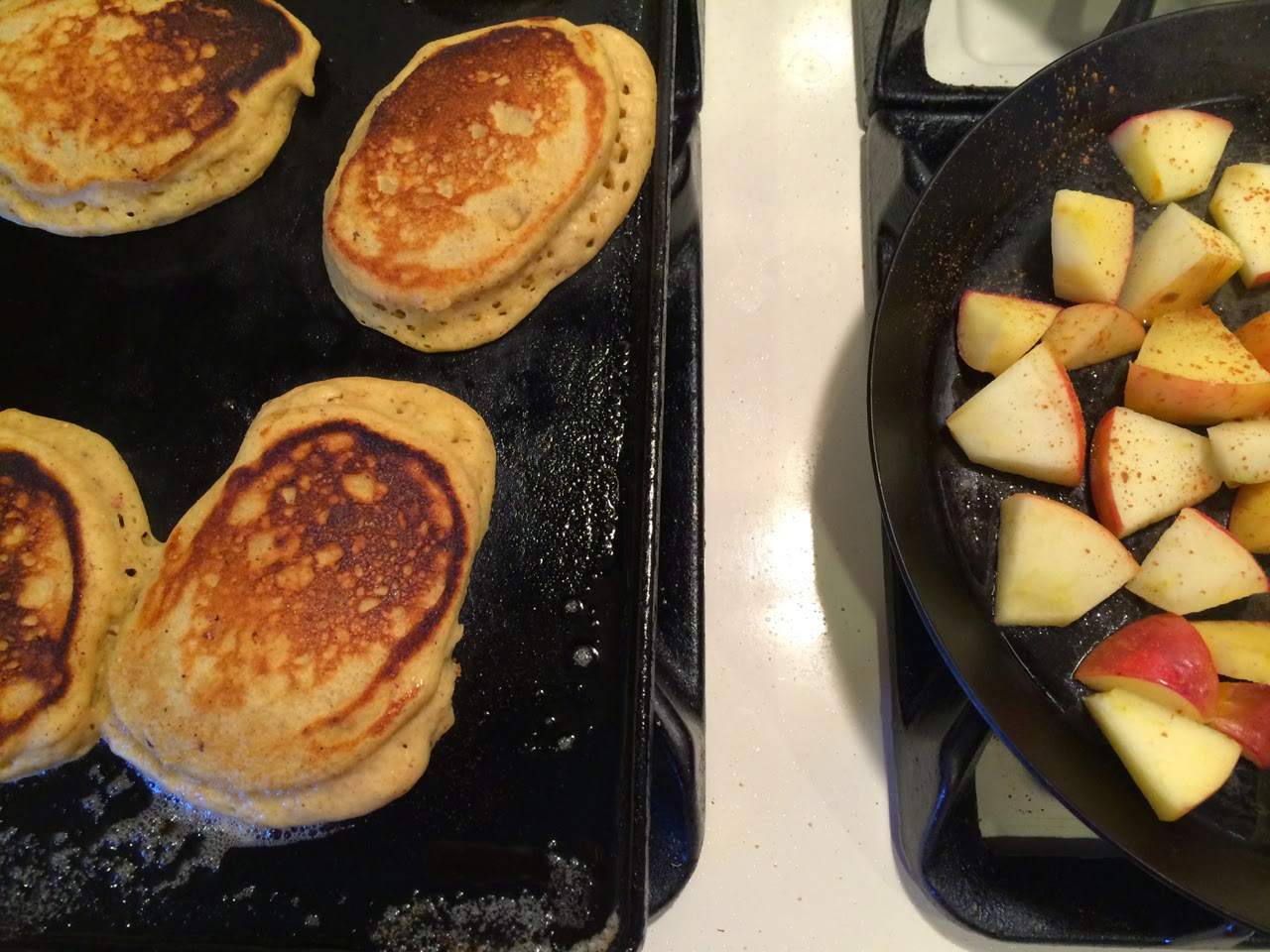
This weekend I roasted two heirloom pumpkins from Sweetwater Farm, and one of their acorn squashes for good measure. Of course this yielded more than enough pumpkin puree for pumpkin pecan praline pie, so at the suggestion of my son, I made some pumpkin pancakes for breakfast.


I paired the naturally sweet squash with the sweet flavor of corn flour (from Lonesome Whistle Farm). No fan of the cloying flavor of pumpkin pie spices, I restricted myself to a dash of ground cardamom in the batter. But for toppings, we made some cinnamon-spiked sautéed apples, that added just the right hint of Thanksgiving dessert. This could make a nice post-Thanksgiving breakfast, if your guests aren't too stuffed.   


Pumpkin Cornmeal Pancakes with Cinnamon Apples
makes about 24 small pancakes
pancake batter
1 cup pureed pumpkin
1/2 cup plain yogurt
2 eggs
1 tsp vanilla extract
1/2 cup white flour
1/2 cup fine ground cornmeal or corn flour
1 tsp baking powder
1/2 tsp baking soda
1/2 tsp ground cardamom
pinch of salt
butter for cooking pancakes

cinnamon apples
1 large or 2 small apples, cored and diced
2 Tbsp butter
1/2 tsp cinnamon
1 tsp turbinado sugar

1. Prepare the pancake batter. Mix together the wet ingredients (pumpkin, yogurt, eggs, vanilla extract) until smooth. In a separate bowl, mix together the remaining dry ingredients. Then gently combine the dry ingredients into the wet ingredients. If the batter seems too thick, add a little milk to thin it.

2. Prepare the apple topping. Warm a small skillet over medium low heat. Melt the butter, and stir in the chopped apples and cinnamon. Cook over low heat for about 15 minutes, stirring occasionally, until the apples are soft and fragrant. Stir in the sugar and cook for a minute longer. Reserve.

3. Heat a griddle and when it is warm, grease with a little butter. Use a soup spoon to spoon the batter into pancakes. When permanent bubbles form around the edge and the color of the batter lightens on top, flip the pancakes and cooked them for a couple of minutes on the second side until both sides are golden brown. 

4. Serve the pancakes hot off the griddle with the apple topping and a dribble of maple syrup.

Sunday, May 11, 2014

Bread Starter Crumpets


Bakers refer to their bread starters as their "mother", but I must admit to harboring maternal feelings towards mine. For the past few weeks, I've fed it when it's hungry, kept it warm, and celebrated its accomplishments. One of the greatest challenges has been to deal with its excessive productively, just like the endless onslaught of artwork that returns in my children's backpacks each day. Sourdough waffles could help, but I needed the moral equivalent of a magical 12 quart minestrone recipe made from macaroni and dried bean collages. 


This crumpet recipe from Chocolate and Zucchini, adapted from King Arthur Flour, is essentially straight fried bread starter. The first time I tried it, my starter was a bit too thick and the baking soda didn't get mixed in well. For my next batch, in a small stroke of frugal kitchen genius, I added some yogurt whey that I had strained out to make a thickened yogurt sauce, which gave it the right consistency and added to the tangy flavor.

Why would someone happen to own crumpet rings, you might ask. Mine were a birthday gift that I received from my future husband shortly after we started dating. Special occasions can be awkward early in a relationship, but he handled the situation charmingly, preparing me a lovely dinner followed by a scavenger hunt for my gift, complete with rhyming clues. At the last clue, I realized with a sudden shock that the gift was going to be a ring, and just as quickly I realized what my answer would be if it were an engagement ring. When I opened the gift, I was overcome with happy relief at knowing I'd met the man I wanted to marry, mischievous scavenger hunts and all, and also knowing that we were only at the crumpet ring stage. Now sixteen years later, we have two children who can help make crumpets for Mother's Day tea.


Bread Starter Crumpets
Yields eight 9-cm (3 1/2-inch) crumpets.*

270 grams (1 cup) bread starter (can use older starter that has been kept in the fridge for a few weeks
)
a little yogurt whey or buttermilk for thinning, if necessary
1 teaspoon sugar
1/2 teaspoon sea salt

1/2 teaspoon baking soda
butter or vegetable oil for greasing

1. Place the starter in a large bowl. Add the sugar and salt, and whisk to combine. The batter should be the consistency of a very thick pancake batter and pourable. If necessary, thin the batter a little with some yogurt whey or buttermilk.

2. Heat a skillet over medium low heat. Grease the crumpet rings well. When the griddle is hot, melt a pad of butter  or pour on a little vegetable oil and spread it around with a spatula. 

3. Just before you are ready to cook the batter, whisk in the baking soda. As the baking soda reacts with the acid in the starter, the batter will foam and rise. Using a measuring cup or a small ladle, pour about 1/4 cup of the batter into each crumpet ring.

4. Cook for a few minutes, until the top is set and the bottoms are lightly browned when you peek underneath by lifting with a spatula. As they cook, the crumpets will gradually shrink back from the rings. Use pliers or tongs to lift the crumpet rings off the crumpets (you may need to run a knife around the edge to help them loose), and flip the crumpets to brown lightly on the other side.

5. Eat the crumpets warm off the griddle or cool them for toasting later. They can also be frozen once cooled. Wipe down the crumpet rings if necessary, re-grease, and place them on the skillet to preheat again before repeating with the remaining batter.

*Note: Clotilde Dusoulier recommends that if you have multiple cups of starter to use up, you should mix the batter in batches with 1 cup of starter at a time, so that the crumpets are cooked shortly after the addition of the baking soda.