Showing posts with label corn flour. Show all posts

Friday, May 1, 2015

Goodbye Bakery and Yogurt Scones


Sad news in the neighborhood: the much beloved Eugene City Bakery will be closing this Sunday May 3, having been evicted by a new owner of the building. DeeAnn Hall's bakery has been a cornerstone of the community and her neighborhood commitment was instrumental in launching the Fairmount Neighborhood Farmers Market five years ago. The loss of this welcoming haven for morning rendezvous and afternoon pick me ups will leave a deep void in the neighborhood. And nowhere on earth could one find a better marionberry scone.


This Mother's Day, we'll be left baking our own scones, and so I'm sharing this recipe for yogurt scones that I tried recently from Clotilde Dusoulier of Chocolate and Zucchini (an authority on baking with yogurt). The dough is quite easy to work with, and I slipped in some Lonesome Whistle Farm corn flour for a bit of extra flavor. We made them plain, served with creme fraiche and jam. Maybe next weekend we'll try layering in some frozen berries, but it won't be the same as ECB's. Their departure is a sad loss for the neighborhood.


makes eight scones
220 grams (1 2/3 cup) flour (I used 1/3 cup corn flour)
25 grams (2 tablespoons) sugar, plus more for sprinkling
1 tablespoon baking powder
1/2 teaspoon fine sea salt
55 grams (1/4 cup) unsalted butter, chilled and diced
125 ml (1/2 cup) plain yogurt (not fat-free)
2 tablespoons plus 1 teaspoon milk (not fat-free)
Your choice of flavoring (optional)
2 teaspoons homemade vanilla extract
1 teaspoon ground spice of your choice
1 teaspoon finely grated citrus zest
2 to 3 tablespoons finely diced dried fruits
2 to 3 tablespoons finely chopped nuts
2 teaspoons orange flower water
2 to 3 tablespoons chopped or grated chocolate

1. Preheat the oven to 175°C (350°F). Line a baking sheet with parchment paper or a silicon baking mat.

2. In a medium bowl, combine the flour, sugar, baking powder, and salt. If you're using vanilla extract, spices, or citrus zest, add them in now.

3. Dice the butter and blend it into the dry ingredients using a fork or pastry cutter, until no visible lump of butter remains.

4. Stir in the yogurt, 2 tablespoons milk, and any dried fruits, nuts, orange flower water, or chopped chocolate you want to use.

5. Turn the dough out onto the counter and knead gently just a few times to form a ball. Handle the dough as lightly as you can and avoid overmixing, or the scones will be tough.

6. Pat the dough into a round, about 12 cm in width and 3 cm in thickness (about 5 inches in width and 1 inch in thickness). Brush the top with the remaining teaspoon milk and sprinkle with sugar.

7. Slice into 8 wedges with a knife or dough cutter.

8. Place the wedges on the prepared baking sheet, giving them a little space to expand.

9. Bake for 15 to 20 minutes, until the scones are set and nicely golden.

10. Serve warm, with an assortment of spreads, such as butter, clotted cream, jam, or honey.

Thursday, December 25, 2014

New England Spider Cake


Christmas brought a few unexpected delights this year, including discovering this decorated tree during a stroll through Hendrick's Park. Another treat was this New England Spider Cake that we had for a late Christmas breakfast (after fortifying ourselves earlier with stollen). I adapted this recipeusing corn flour, polenta, and soft white flour from our newest CSA installment from Lonesome Whistle Farm, and we ate it topped with poached quince. This cake is just the thing to slip in the oven, along with a tray of bacon, to bake while opening presents. The final dish is a kind of cornmeal spoon bread, and apparently gets is name from the spidery cracks emanating from the center of cream, which is itself an unexpected custardy treat.


New England Spider Cake
1/2 cup corn flour (I used Lonesome Whistle Farm's corn flour)
1/2 cup coarse corn meal (I used Lonesome Whistle Farm's polenta)
3/4 cup all-purpose flour (I used Lonesome Whistle Farm's soft white wheat)
1/2 cup sugar
½ teaspoon baking soda
½ teaspoon salt
2 cups buttermilk
2 eggs
2 tablespoons butter
1 cup heavy cream

1. Preheat the oven to 350 degrees and place a 12-inch cast iron skillet in the oven to warm.  Combine corn flour, cornmeal, flour, sugar, baking soda and salt. Whisk eggs into the buttermilk. Stir into dry ingredients and set batter aside.

2. Remove the skillet from the oven and melt the butter in the hot skillet. Pour in the batter. Pour the cream into the center, slide the skillet into the oven and bake until golden brown on top, about 45 minutes. Slice into wedges and serve warm.

Sunday, November 23, 2014

Pumpkin Cornmeal Pancakes


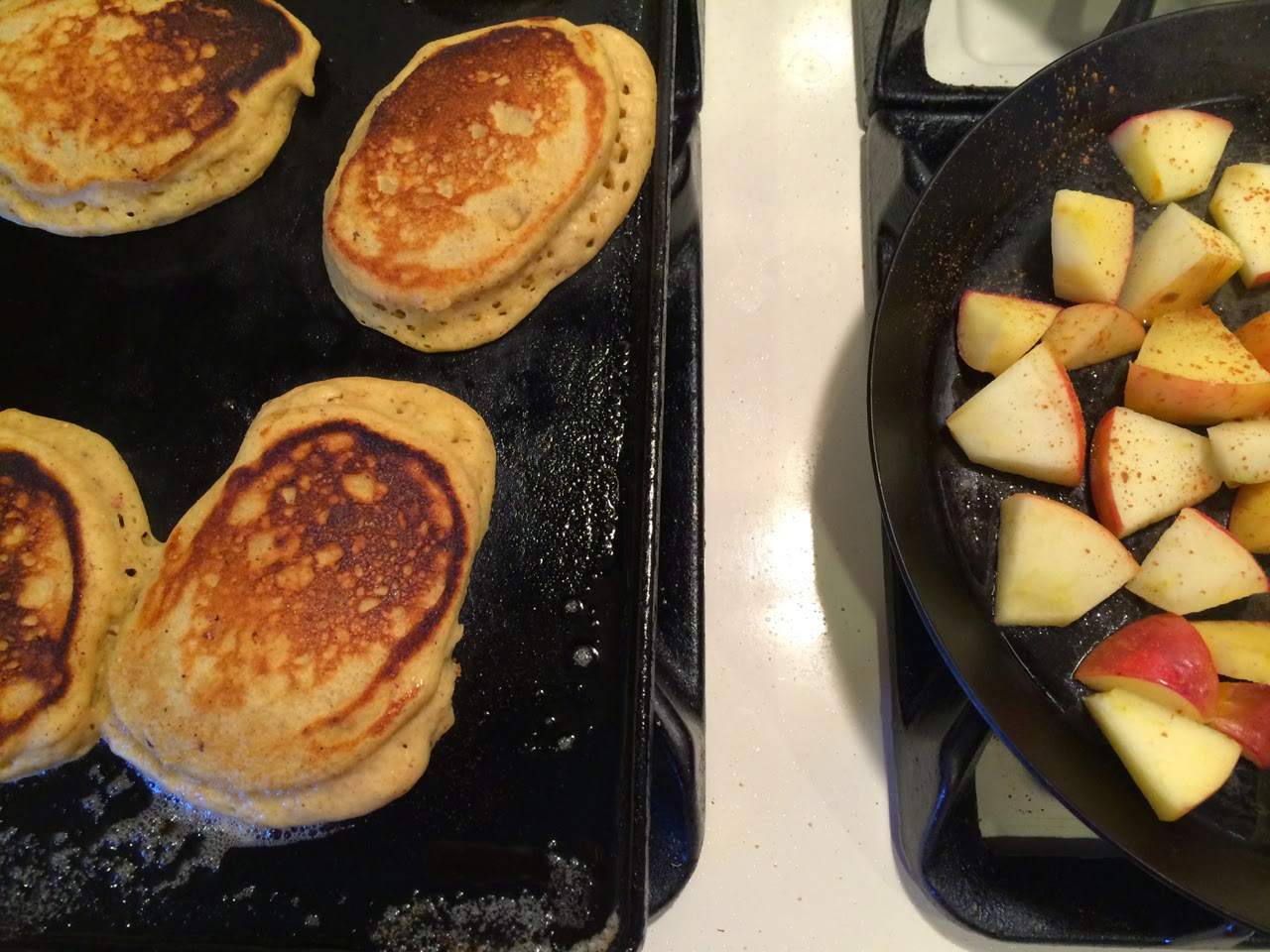
This weekend I roasted two heirloom pumpkins from Sweetwater Farm, and one of their acorn squashes for good measure. Of course this yielded more than enough pumpkin puree for pumpkin pecan praline pie, so at the suggestion of my son, I made some pumpkin pancakes for breakfast.


I paired the naturally sweet squash with the sweet flavor of corn flour (from Lonesome Whistle Farm). No fan of the cloying flavor of pumpkin pie spices, I restricted myself to a dash of ground cardamom in the batter. But for toppings, we made some cinnamon-spiked sautéed apples, that added just the right hint of Thanksgiving dessert. This could make a nice post-Thanksgiving breakfast, if your guests aren't too stuffed.   


Pumpkin Cornmeal Pancakes with Cinnamon Apples
makes about 24 small pancakes
pancake batter
1 cup pureed pumpkin
1/2 cup plain yogurt
2 eggs
1 tsp vanilla extract
1/2 cup white flour
1/2 cup fine ground cornmeal or corn flour
1 tsp baking powder
1/2 tsp baking soda
1/2 tsp ground cardamom
pinch of salt
butter for cooking pancakes

cinnamon apples
1 large or 2 small apples, cored and diced
2 Tbsp butter
1/2 tsp cinnamon
1 tsp turbinado sugar

1. Prepare the pancake batter. Mix together the wet ingredients (pumpkin, yogurt, eggs, vanilla extract) until smooth. In a separate bowl, mix together the remaining dry ingredients. Then gently combine the dry ingredients into the wet ingredients. If the batter seems too thick, add a little milk to thin it.

2. Prepare the apple topping. Warm a small skillet over medium low heat. Melt the butter, and stir in the chopped apples and cinnamon. Cook over low heat for about 15 minutes, stirring occasionally, until the apples are soft and fragrant. Stir in the sugar and cook for a minute longer. Reserve.

3. Heat a griddle and when it is warm, grease with a little butter. Use a soup spoon to spoon the batter into pancakes. When permanent bubbles form around the edge and the color of the batter lightens on top, flip the pancakes and cooked them for a couple of minutes on the second side until both sides are golden brown. 

4. Serve the pancakes hot off the griddle with the apple topping and a dribble of maple syrup.

Sunday, October 12, 2014

Cornmeal Plum Scones


We'll have to get used to a different Sunday morning routine now that the Fairmount Neighborhood Farmers Market is done for the season. As my sister-in-law taught me this summer, making scones is a manageable morning task for a late breakfast, so my son and I whipped up these tasty scones from Melissa Clark, with plums from Sweetwater Farm and corn flour from Lonesome Whistle Farm.


For this recipe, you make a quick plum jam with caramelized honey and a bay leaf, and then layer this right into your scone dough triangles, resulting in some nice caramelized plum pieces on the top of your scones when they come out of the oven. 


To be enjoyed with extra plum jam, a second cup of tea, and another section of the Sunday newspaper as the morning fog burns off.


Cornmeal Plum Scones
3 tablespoons/45 milliliters honey
1 bay leaf
¾ pound plums/1/3 kilogram (~20 small), halved, pitted and then cut into 1-inch cubes
¾ cup/175 milliliters heavy cream, more as needed
1 large egg, at room temperature
1 ⅔ cups/275 grams all-purpose flour
⅓ cup/60 grams fine cornmeal
3 tablespoons/35 grams sugar
2 teaspoons/7 grams baking powder
½ teaspoon/2 grams kosher salt
6 tablespoons/85 grams unsalted butter at room temperature, cubed, plus more for serving if you like

1. Put honey and bay leaf in a medium skillet over medium heat. Simmer until honey is bubbling and turns a shade darker, about 2 minutes.

2. Place plums in honey. Cook, without moving, until undersides are golden brown, about 5 minutes. Stir plums and cook 1 to 2 minutes longer, until tender but not falling completely apart. If the caramel starts to get too brown, stir in a teaspoon or two of water and lower the heat. Scrape plums and syrup into a bowl and chill for at least 1 hour. (Plum compote can be made up to a week ahead.)

3. Heat oven to 400 degrees. Line a baking sheet with parchment.

4. In a small bowl or measuring cup, mix together the cream and egg.

5. In a large bowl, whisk together flour, cornmeal, sugar, baking powder and salt (or you can do this in a food processor). Using a fork, pastry cutter or your fingertips, cut butter into flour until the mixture forms coarse crumbs (or pulse in a food processor). Drizzle in as much of the cream mixture as you need to make a smooth, moist but not wet dough. Save remaining cream-egg mixture for brushing.

6. Turn dough out onto prepared baking sheet. Pat into a 1 1/4-inch thick round. Using a paring knife, cut 8 wedge-shaped scones (as though you were cutting slices of pie) and push them apart on the baking sheet to separate them 1/2 inch apart. Brush dough with remaining cream-egg mixture, or use more cream if you’ve run out of the mixture.

7. Using your fingertips, make a deep indentation about 1 inch in diameter in the center of each scone. Tuck some plum into the hole. Transfer pan to oven and bake until uniformly golden brown, 15 to 17 minutes. Cool 5 minutes on the pan, then transfer to a wire rack to cool completely. Serve scones with extra plum compote and butter on the side if you like.

Friday, November 22, 2013

Thanksgiving Menu


It's time to get serious about Thanksgiving menu planning. We'll be enjoying a Fair Valley Farm turkey, and we're going to try spatchcocking itFor vegetable sides, I'm planning on making delicata squash wedges and stir-fried brussels sprouts, brightened with lemon.


The stuffing will be made with cornbread.


And for dessert, I'm making a family favorite of praline pumpkin pie.


Many thanks to the local growers whose produce will grace our table. Happy Thanksgiving!

Saturday, May 11, 2013

Rhubarb Cornmeal Scones


The lovely rhubarb in the markets these days had got me thinking about rhubarb scones, and Mother's Day seemed like a good occasion to make some. We still have plenty of corn flour from our Lonesome Whistle Farm CSA, so I decided to experiment with a rhubarb cornmeal scone, inspired from here and here.


The rhubarb got a dousing of sugar while I made a buttery dough in the food processor, and then mixed in the fruit at the end.


The dough was soft and a bit sticky on our unusually warm May day, but it didn't need much handling: just a gentle pat into two disks that I sliced into sixths and popped into the oven. The resulting corn-flavored scones, studded with tart rhubarb, were such a hit that I was barely able to save some for Sunday morning.  


Rhubarb Cornmeal Scones
makes 12
4 small rhubarb stalks, trimmed and cut into 1/4 inch slices (1 cup)
1/2 cup sugar (divided)
1/2 tsp vanilla extract
1 cup corn flour or fine corn meal (I used Lonesome Whistle Farm corn flour)
1 cup whole wheat white flour (I used Lonesome Whistle Farm Stephen's White)
1 tsp baking powder 
1/4 tsp baking soda
1/2 tsp salt
8 Tbsp (1 stick) butter, cut into 1/2 inch cubes
1/2 cup buttermilk

1. Preheat the oven to 375 degrees (unless you plan to freeze the scones and bake later). 

2. Rinse, trim, and cut the rhubarb into 1/4 inch slices (yielding 1 cup). Sprinkle over 1/4 cup sugar and the vanilla extract and stir.

3. In a food processor, combine the corn flour, wheat flour, 1/4 cup sugar, baking powder, baking soda, and salt. Add the cubed butter and pulse into pea-sized pieces. Transfer to a mixing bowl (you can also incorporate the butter into the flour by hand or using a pastry knife). Pour in the buttermilk and incorporate it into the dough. Add the sugared rhubarb and stir gently to incorporate.

4. Cover a baking sheet with a silicone mat or parchment paper. Transfer the dough onto a floured surface, such as a silicone mat, and divide into two. Gently form into two disks, about 1 1/2 inches tall, dusting with flour as necessary. If the dough seems too sticky to handle, chill it at this point for 15 minutes in the freezer or longer in the refrigerator. Cut each disk into 6 pie slice wedges. Transfer the wedges to the baking sheet. 
Note: You can freeze the scone wedges at this point and bake them later (add an extra 5 minutes to the baking time).

5. Bake at 375 degrees for about 25 minutes, rotating the pans 180 degrees half way through the baking. The scones are done when they are a golden all over the top. Cool before eating.

Friday, February 22, 2013

Orange Upside Down Polenta Cake


Our latest installment of Lonesome Whistle Farm polenta inspired me to experiment with this grain in desserts. Searching around, I came across a genre of recipes for Italian polenta cake made with almond meal and often with citrus. The red hues of this colorful corn reminded me of ruby red blood oranges, and its coarse texture seemed at home in a skillet, so I decide to make a rustic upside down cake in my cast iron pan.


I used an amalgam of a polenta cake from Nigella Lawson and an orange caramel layer from Yotam Ottolenghi. I have to admit to being a novice when it comes to caramelizing sugar (I should have watched this first), and tried to take a short cut by melting the sugar in the skillet, but my caramel developed some crystals in the process. Despite this setback, I persevered, because a few sugar crystals didn't seem so bad in the grand scheme of things, and really, who could resist a cake as lovely as this on one side, 


and this on the other. It had a coarse and slightly crumbly texture that suited its skillet inception, but was moist and rich and busting with orange flavor. This cake will definitely become another regular use for our polenta supply.


Orange Upside Down Polenta Cake
adapted from recipes by Nigella Lawson and Yotam Ottolenghi 

for the caramel orange layer 
1/2 cup superfine granulated sugar
2 tablespoons water
2 tablespoons unsalted butter, cut into bits
2 blood oranges

for the cake
1 3/4 sticks (14 tablespoons) soft unsalted butter
1 cup superfine sugar
2 cups almond meal/flour
3/8 cup coarse polenta
3/8 cup fine cornmeal
1 1/2 teaspoons baking powder
3 eggs
zest from 2 blood oranges

1. Preheat oven to 350°F with rack in middle. Wash the oranges and zest them with a microphone grater. Reserve the zest and cut off the peels and pith. Slice them into 5 or 6 slices perpendicular to the axis of the sections and remove any pith in the interior.

2. Make the caramel orange layer. In a small, clean, heavy saucepan, combine the sugar, water and a dribble of juice from slicing the prongs. Bring to a boil over medium heat, stirring until sugar has dissolved, and then STOP stirring. Wash down any sugar crystals from side of pan with a pastry brush dipped in cold water. Boil, without stirring, swirling pan occasionally so caramel colors evenly, until dark amber.

3. Remove from the heat and add butter, swirling pan until incorporated, then carefully but quickly pour caramel into a well-seasoned 10 inch cast iron skillet (if in doubt, oil your skillet a bit). Tilt the skillet to coat evenly and arrange the orange slices in the caramel with the largest slice in the center and other slices surrounding it in a circle.

4. For the cake, beat the butter and sugar till pale and whipped, either by hand in a bowl with a wooden spoon, or using a freestanding mixer or food processor.

5. Mix together the almond meal, polenta and baking powder, and beat some of this into the butter-sugar mixture, followed by 1 egg, then alternate dry ingredients and eggs, beating all the while. Finally, beat in the lemon zest and pour, spoon or scrape the mixture into your caramel and orange lined skillet. 

6. Bake in the oven for about 45 minutes. If the cake is cooked, a cake tester should come out clean. Remove from the oven and allow to cook for about five minutes. Place a large plate over the skillet, confidently invert the skillet and allow the cake to slide onto the plate. Allow to cool to room temperature and serve. 

Saturday, February 2, 2013

Cornmeal Popovers


The popover recipe in the children's cookbook Pretend Soup by Mollie Katzen (of Moosewood fame) is the perfect gateway project for budding chefs. Both my children loved pouring over the cartoon instructions, and the first word they learned to read was "EAT", the last step of every recipe. As a parent, my favorite part of the book is the collected words of wisdom at the beginning, "Children's Own Rules", which includes such sage advice as: "It's not okay if you spill on purpose" and "The most important rule of all is don't cook in a volcano."


The great thing about this recipe is that it's so reliable and resilient, producing consistently delicious popovers after all the haphazard sloshing and spilling that is to be expected of young cooks. Thus, it occurred to me that this recipe could handle a little tinkering, so in my last batch, I slipped in some of my Lonesome Whistle Farm corn flour. The result was delicious; the simple milk batter let the fresh corn flavor of the flour shine.


These popovers are wonderful with butter and jam, and they also made a lovely lunch with a salad of blood oranges, hazelnuts and a medley of endives, escarole, and radicchio from Open Oak Farm.  And both will make nice accompaniments to tomorrow's Super Bowl pot of chili.


Cornmeal Popovers
adapted from Mollie Katzen and Ann Henderson's Pretend Soup
makes one dozen popovers

2 Tbsp butter
2 eggs 
1 cup milk
2/3 cup white flour
1/3 cup fine cornmeal or corn flour
1/4 tsp salt

1. Preheat the oven to 375 degrees.

2. Melt the butter and use it to brush the insides of 12 muffin tins.

3. Whisk together the milk and eggs very well. Now whisk in the remaining melted butter and the salt. 

4. Mix together the flours and stir them into the batter until they are just incorporated.

5. Use a 1/4 cup measuring cup or small ladle to fill the batter into the muffing cups, filling them about halfway up.

6. Bake for 30 minutes without opening the oven. 

7. Remove the popovers from the pan and EAT!

Tuesday, November 20, 2012

Skillet Polenta Cornbread


In the bounty of a Thanksgiving feast, cornbread is always a welcome addition. Here I adapted my favorite skillet cornbread, from Cook's Illustrated, to a combination of Lonesome Whistle Farm's gorgeous multicolored polenta and freshly ground corn flour. The polenta gives it texture and crunch, while the corn flour keeps it light, and both provide an intense corn flavor.


As your cast iron skillet warms in the oven, mix up a polenta mush and whisk it into a buttermilk slurry. Then melt the butter (or bacon lard) in the skillet, quickly incorporate the dry ingredients into the batter, stir in the melted fat, and pour the batter back into the hot skillet. The batter will sizzle as it hits the cast iron, releasing the fragrant smell of toasted corn. 


This recipe calls for an 8 inch cast iron skillet, which I don't own. I found that doubling the recipe works well for my 10 inch pan (with an extra 5 minutes for baking). About half the recipe will fill my cast iron corn mold, and the other half makes a cute 6 inch skillet  bread. In any shape or size, this cornbread is delicious with a slab of cheddar cheese or slathered with homemade jam, like my husband's quince, hardy kiwi, and raspberry concoction here. A bite of this bread will make you thankful for the bounty of our fertile valley.


Skillet Polenta Cornbread
Adapted from Cook's Illustrated Southern Style Cornbread (publish May, 1998)
Makes one 8 inch skillet bread (double recipe for a 10 inch skillet)

2/3 cup corn flour
2 tsp sugar
1/2 tsp salt
1 tsp baking powder
1/4 tsp baking soda

1/3 cup polenta
1/3 cup boiling water
3/4 cup buttermilk
1 egg
2 Tbsp butter (or 4 Tbsp bacon lard)

1. Preheat the oven to 450 degrees. Place an 8 inch cast iron skillet (or two cast iron corn muffin molds on baking sheets) in the oven.

2. Mix together the dry ingredients of corn flour, sugar, salt, baking powder and baking soda.

3. In a large glass or ceramic bowl, our the boiling water over the polenta and whisk to make a stiff mush. Slowly whisk in the buttermilk, making sure there are no lumps, and then whisk in the egg.

4. When the oven is hot, take the skillet out of the oven and place it over medium low heat on the stove. Melt the butter or bacon lard. If using muffin molds, take them from the oven and brush them generously with melted fat. Working quickly, stir the dry ingredients into the polenta mixture just until they are incorporated. Then pour the melted butter into the batter, stir quickly, pour the batter into the skillet or molds, and put them back in the oven.

5. Bake until the corn bread is golden brown and a skewer comes out clean, about 20 minutes for a skillet bread and 15 minute for muffins. Turn the bread or muffins onto a wire rack, cool for five minutes, and serve warm.  

Monday, January 30, 2012

Fresh Corn Tortillas


The best kind of present is one that arrives out of the blue, a package on your doorstep when you are least expecting it. A couple of weeks ago the mailman left me a tortilla press, a thoughtful early birthday gift from my sister-in-law. I'd never made fresh tortillas before, but now I had a mission. It turns out that corn flour and water are lots of fun to mix, squishing between your fingers, especially if you are four.


Although at first it seems like a crumbly mess, the mixture comes together into a smooth, soft dough. The tricky part is handling it after it has been flattened. You need to line the press with plastic wrap, and avoid pressing the dough too thin. Here again, being four comes in handy because your maximum strength produces a tortilla that's just sturdy enough to peel off intact from the plastic wrap and place onto a hot griddle.


The resulting hot tortillas were pliant and flavorful. We piled them with this tomatillo pork and beans made with Arikara beans from Lonesome Whistle Farm, accompanied by crunchy slaw with cabbage and radishes from Open Oak Farm, and this roasted delicata squash. Making these tortillas is really quite easy and quick, even feasible on a weeknight as a little surprise gift for the whole family.


Corn tortillas
adapted from Rick Bayless, makes about 12 tortillas

1 3/4 cup masa harina (fine corn flour, I used Maseca brand)
1/2 tsp salt
1 cup water, or a little more

1. In a bowl use your hands to mix the water into the masa and salt, adding the liquid in several steps, until it comes together into a smooth dough. Cover and let rest for a few minutes. 

2. Heat a large two burner griddle or two skillets, one medium and one medium high.

3. Check that the dough doesn't feel to stiff and add another 1-2 Tbsp of water if necessary. Divide the dough into 12 equal pieces, roll into balls, and cover with plastic wrap.

4. Cover both faces of the tortilla press with plastic wrap (or use a plastic bag cut to fit). Place a ball of dough between the sheets of plastic and gently press to form a 1/8 inch thick disc.

5. Gently peel the plastic wrap from the dough, positioning you hand so that it supports the tortilla with your index finger at the top of the center. Hold the tortilla over the medium hot griddle with your hand underneath. Tilt your hand so that the edge of the tortilla parallel to you hand sticks to the skillet and then gently lay the tortilla onto the skillet as you roll your hand out from underneath it. 

6. Cook the tortilla for about 30 seconds until it no longer sticks and the, using a metal spatula, flip it over onto the medium hot part of the griddle. Cook for about 30 seconds and flip again. Cook for another 30 seconds, until both sides browned in parts. Transfer to a basket with a towel to keep the tortillas warm. Keep cooking all the tortillas in an assembly line, stacking them on top of each other to keep warm. Enjoy immediately.